The Ashram celebrates Navratri twice a year, during spring and fall. Please check our Calendar of Events to find out exact dates.
Navratri, or the Divine Nine Nights, is a time of deep rest and rejuvenation. Each day is dedicated to one of the nine forms of the Mother Divine. The celebration at the Ashram is done during the mornings of these nine days. The nights are for your personal practice to go deep within to realize the Divine Mother in your life. These nine spectacular days are to focus on our beloved Divine Mother, who gives us everything.
The mornings are filled with ceremonies. This is a brief list of activities, with further details provided below.
- Paduka Puja
- Aarati
- Devi Puja
- Haidakhandi Saptasati
- Fire Ceremony
- Chanting and Discourse
- Festive Meal
Mornings start with Paduka Puja and Aarati, the normal daily activities at the Ashram. Paduka Puja is a ritual that involves the worship of the holy sandals (Padukas) of the Guru, symbolizing humility, surrender, and seeking the blessings and presence of the divine. It is performed to express gratitude, invoke spiritual energy, and foster a deeper connection with the Guru or God, even in their physical absence. Aarati is where light, usually from a lamp, is offered to Deities and Guru, accompanied by devotional songs and prayers. It's a way of expressing love, gratitude, and reverence towards the divine. The light is believed to purify the atmosphere and the devotee, symbolizing the removal of darkness and ignorance.
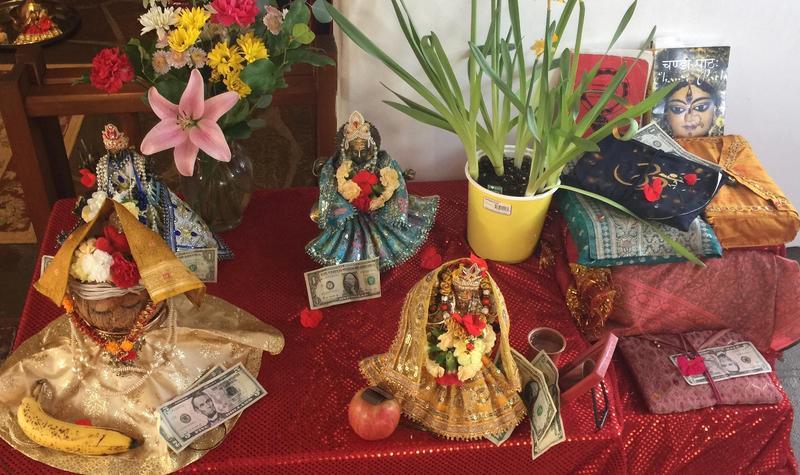
The first unique ceremony of the day is Devi Puja at 8:30am. The first three days we focus on Mother Durga asking Her to annihilate any parts of us that keep us from our spiritual path. The second 3 days we focus on Maha Lakshmi asking Her to fill us with Satvic (pure, peaceful, loving) qualities. And the final three days we focus on Mother Saraswati asking Her to give us the Rajasic energy to bring all our new qualities into the world and into our heart. If you wish to sponsor one of these pujas, just go to our Donate Page and let us know which day.
After Devi Puja, we read the Saptasati. The Haidakhandi Saptasati is an enchanting and inspiring text filled with 700 verses praising the Divine Mother in the form of Haidakhandeshwari. This exquisite prayer was written by Shastriji with the blessings of Mahendra Maharaj. When Shastriji came to Vrindavan and recited the Saptasati for the first time showing his work, Mahendra Maharaj started dancing around the temple grounds holding the written version on his head.
We then have the Sacred Fire Ceremony at 11am. Each day there is a special aspect of the Mother we remember. This is then followed by chanting, discourse (typically inspiring stories from the Devi Bhagvatam), and a festive meal.
Day One: Ma Shailputri
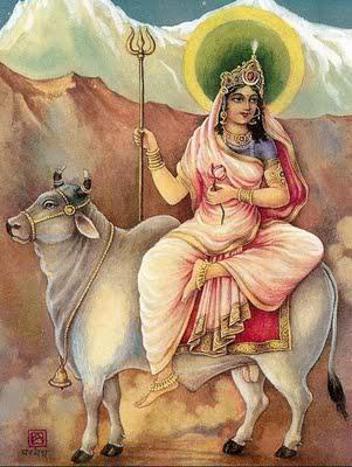
Navratri begins with the worship of the Ma Durga in the form of Shailputri Devi, whose name means Daughter of the Mountain. In fact Shailputri is the daughter of the king of the Himalayas, and is considered the purest incarnation of Mother Durga. Her color is red, her planet the Moon. She is associated with the Muladhara Chakra.
Day Two: Ma Brahmacharini
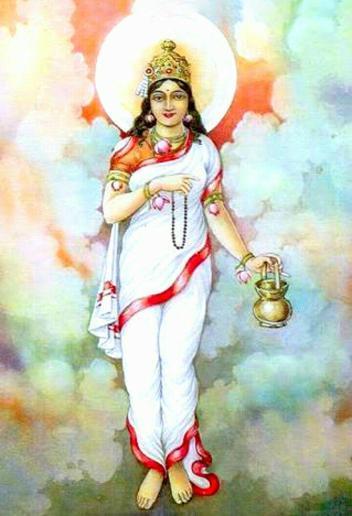
The benign and peaceful form of Brahmacharini brings serenity and calmness in the mind and instills a great degree of self-confidence. As Brahmacharini, the Divine Mother is the greatest Yogini and a Guru to the world. Brahmacharini means in whom the nature of Parabrahma (divine consciousness) is prevalent, so by worshiping Her the ultimate nature of your own self, which is the Goddess, will come alive in your experience. She is meditated upon in a peaceful form where she holds rosary and kamandalu in Her hands, which both are symbols of spiritual austerities for divine realization. As Parvati, when She performed her penance, even Brahma, Vishnu, Shiva, and Saptarishis bowed down to Her as Her penance stood unparalleled and highest among all yogis. She is the Goddess who is worshiped by all Yogis and realized sages. She is the storehouse of knowledge and wisdom.
Day Three: Ma Chandraghanta
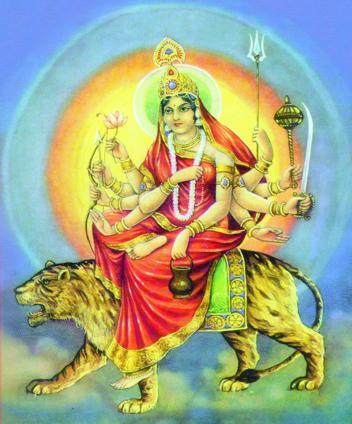
As Chandraghanta, Divine Mother is a fiery warrior who takes down all evil endlessly. She is meditated upon with a ten armed form holding trident, mace, sword, bow, arrow, lotus, rosary, kamandalu, Abhaya, and Vara mudras. She is seated on a tiger. The purpose of worshipping Goddess Chandraghanta, the third manifestation of Devi Durga, is both related with internal and external situations. Chandraghanta has a mark of moon on her forehead, which represents Her calmness and meditativeness. She is a fierce Warrior who is always taking down Asuras in war, but still She's untouched by anger. She's always internally calm but at the same time very active in doing Her job. This form of Mother teaches us about inner balance, as many times we lose our balance and react senselessly which is followed by regret. So with the worship of Chandraghanta, Her devotee is reminded to remain calm and react in any situation only after clear analysis.
Day Four: Ma Kushmanda
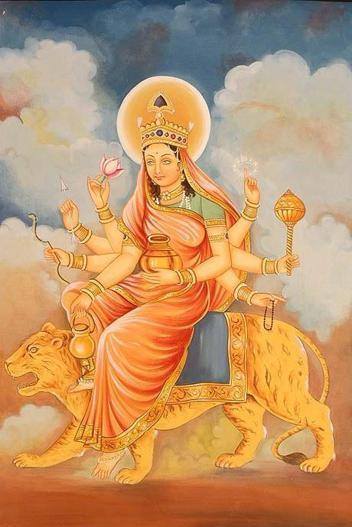
As Kushmanda among the nine Durgas, as Mahalakshmi in Shrimad Devi Bhagawatam and as Kamakhya in tantras, Devi is regarded as the very source of everything. She is regarded as universal mother simply because everything that exists is born out of her. She is the womb / source from which Shiva (time), Vishnu (space) and Bramha (matter) are also born, she is the Mother of all gods.
Kushmanda means from whose ushma / self energy, the Bramhanda (universe) is born. She is the mother Goddess to everything that is animate and inanimate. Creations have born out of her and goes back to her. She is the beginning, and she is the end of the cosmos.
Devi is consciousness and bliss incarnate as Saguna which is worshiped as Kamakhya, Mahalakshmi, Lalita, Kalika, and other Vidya forms of her. She is also formless, unknown or unseen as Nirguna parabramha. In form and as formless both ways she exists. When she's in a form she becomes the mother and creates life and universes, when she becomes formless she devours everything back within herself.
Goddess is regarded as the supreme Godhead in Hindu spirituality, almost every scripture speaks in volumes of her being the very source of the universe.
Day Five: Ma Skanda Mata
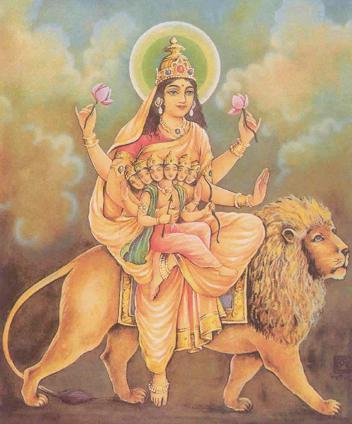
As Skanda Mata, the Goddess is Mother to Kartikeya. Kartikeya is known as Deva Senapati, the commander in chief of Gods. He takes down all the negativity / Asuras which are offsprings of material desires in the mind. As her son, he clears the path for her devotee by defeating all the compulsions in our mind.
Once peace and silence takes over mind, the devotee becomes meditative and he or she experiences the Divine consciousness which is Devi, or Skanda Mata. Skanda or Kartikeya has six heads, which represents his victory over six kinds of disorders in human mind. He holds the shoola which is given by his Mother to fight against evil. Worship of Skandmata, bestows the grace of both Kartikeya swami and Jagadamba to a devotee. We invoke the blessings of fifth manifestation of Devi Durga, the Mother of Skanda (kartikeya), the leader of the celestial army that is overpowering the lower tendencies of our human nature. We can do our devotional part by honoring Skanda Mata today and pay full awareness to our thoughts and actions.
Day Six: Ma Katyayani
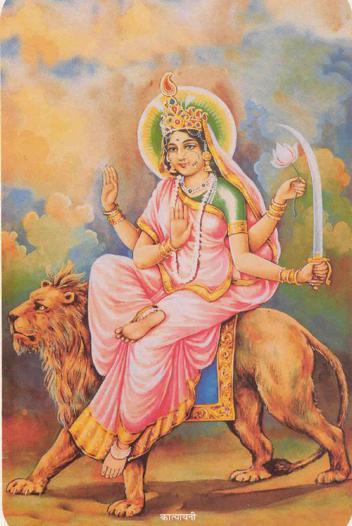
Katyayani is the daughter of Sage Katyayan, he worshiped Ambika to grant protection from all evil forces to the society. Pleased by his tireless penance and oblations to fire / homa, the Goddess appeared and asked him to ask for a boon. Katyayan replied if you'll be born as my daughter and protect the world from Asuras it would be his greatest fortune. The Devi smiled and gave him his desired boon.
Goddess Katyayani is none other than Mahishasura Mardini, the slayer of buffalo demon who terrorized even Bramha, Vishnu, and Shiva. Katyayani is a ferocious warrior form of Goddess whose name itself terrorizes the negative forces. She's ferocious but compassionate at heart.
Katyayani is the spiritual fire in a human being who takes down the six enemies of Kama (lust), Krodha (anger), Lobha (greed), Moha (attraction), Mada (pride), and Matsarya (jealousy). Mahishasura is a unified form of these enemies hence he can only be slayed by the Divine consciousness which is Mother Katyayani. She holds the chandrahaasa sword, which destroys negativity and grants meditative mind.
Katyayani is the great power of transformation, who transforms compulsions into positive actions. She refines the inner nature of a spiritual aspirant and makes him/her fearless to go deeper into the spiritual depths of their own self. On the auspicious occasion of Maha Shashthi, we invoke the blessings of sixth manifestation of Devi Durga, Mata Katyayani.
Day Seven: Ma Kaalratri
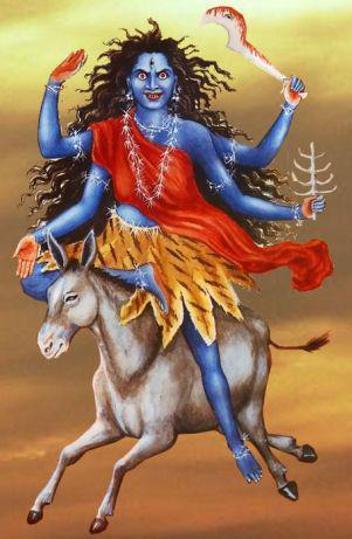
Kaalratri is the most fierce one among the nine durgas, simply because she gives the highest realization to her devotee by annihilating his / her mortal limitations and grants them fearlessness. Her fierceness represents her higher intensity, as even her ornaments are nothing else but high voltage electric waves. Highly intense means she gives transcendence to her bhakta easily by making them quickly suffer their accumulation of past mortal karmas.
She is meditated upon in a form with untied long hair, she is digambara or naked as she is the entire cosmos and there can hardly be any clothes made for her as external covering because she is everything. She holds a shiny sword and a Vajra (thunderbolt) in left upper and lower hands and abhaya and Vara mudras in right upper and lower hands. She's seated on a gardabh / donkey, which shows that every creature is beloved of Divine Mother. Her face expression is Raudramukhi / fierce with wide big open eyes and a gentle smile on her lips.
In Durga Saptashati, Kaalratri is mentioned along with the three spiritual nights. Kaalratri means the night of dissolution. Absolute darkness in which nothing can be seen or known. Only when there is light, you can find a sense of duality in terms of the existence of a matter in some space and time. Here, in absolute darkness, there is no existence of matter. She either stops time or has devoured the time itself. In absence of time, the space can't be formed, and matter becomes static. As earlier told her ornaments and body are charged electric waves which reveals that anything which goes close to her will merge / dissolve in her. She'll release them from mortality, hence she grants Moksha or liberation to her devotees. She destroys fear in her devotee's mind and grants them wisdom to cross the ocean of samsara / physical life effortlessly. On the auspicious occasion of Maha Saptami we invoke the blessings of Ma Kaalratri to destroy all negativities in our lives.
Day Eight: Ma Mahagauri
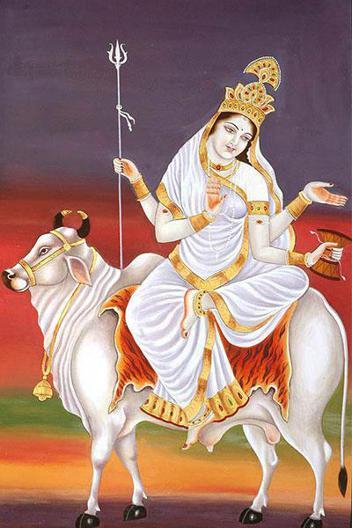
Mahagauri is the kriya Shakti of existence. Kriya means action, the energy which creates motion in static matter is Mahagauri. She is the eighth manifestation of Goddess Durga who is worshiped on Maha Durgashtami. She is the beloved wife of Lord Shiva, who is meditated upon seated on Nandi, the bull. She has four hands in which she holds a trident, damru, Abhaya, and Vara mudras. She has a blissful expression on face.
Mahagauri also represents the union of Shiva with Shakti. She completes him by merging him with herself, which makes him Ashutosh. Shiva grants auspicious boons to his devotees only when he is united with Shakti, without her, he becomes dispassionate and has no purpose in existence. The reason Mahagauri plays a Damru represents that divine union of Shiva and Shakti. Their union is considered auspicious for continuance of existence, so Mahagauri embodies the greatest Auspiciousness. She is the creator of life, the Yoni from whom the creation takes birth. She is mother to all life forms. Her worship grants experience of oneness with all lives. When one feels the same amount of love and compassion for everyone, the oneness can be felt. This oneness is auspiciousness of Mahagauri, as it reduces friction and stress in our surrounding and creates acceptance and harmony, for smooth functioning of life. The purpose of spirituality is to reduce external friction to go deep inside your spiritual self. Mahagauri provides this kind of transformation with her worship.
With our worship and concentration on the Divine Mother today, on Astami we invoke the blessings of ever auspicious and blissful Mother Goddess Mahagauri.
Day Nine: Ma Siddhidatri
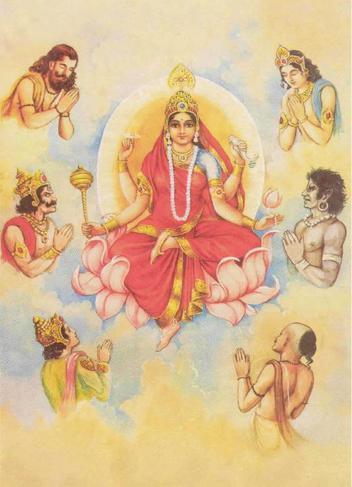
The ninth and final manifestation of Ma Durga is known as Shri Siddhidatri. Siddhidatri means the one who grants you all kinds of auspicious accomplishments / strengths known as Siddhis. Siddhis are unparalleled strengths in terms of different kinds of masteries which help you pass through the austere spiritual path effortlessly with her grace. Siddhis are of different kinds ranging from attaining an exceptional intelligence to supernatural powers, but the ones who fall in the trap of powers live a limited life and remain deprived of liberation / Mukti. Siddhis are not the ones a sadhaka must bother too much about, if they come or not is her choice. If you are not prepared consciously such strengths can also become disastrous. It is like you handing over a knife to a child who has just learned to step up on his feet. If your priority is only Mother than such strengths will not boost arrogance, rather they'll be helpful in attaining divine realization.
It is said Lord Shiva himself worshiped this manifestation of the Devi and with her grace attained all Siddhis. Shiva is Dakshinamurti himself, the ultimate master of all kinds of spiritual sadhanas. He attained his completeness through His union with the Goddess. As She became His left half, He became the master of everything.
Siddhidatri Devi is an all inclusive figure, from Devas and deities, to Sages, seers and priests, to all kinds of human beings and even the Demons / Asuras are Her devotees. She is the universal Mother, all complete and powerful in Herself. As She sustains everything and everyone, naturally everyone bows down at Her feet. Mother never discriminates among Her children, thus Ma Siddhidatri sees all her devotees as equal. A beautiful quality to learn from Her, if today the world drops each other's differences and realize it's universal identity definitely there will be peace and harmony everywhere.
If you are thinking to sponsor a fire ceremony or puja, you may want to consider the different aspects each day. Once again just go to our Donate Page and let us know what day you wish to sponsor.
All of the above ceremonies get live-streamed during Navratri including the chanting and discourse after the fire ceremony. You can find them at Haidakhandi Universal Ashram Facebook Page and then they will be posted on our YouTube Channel.